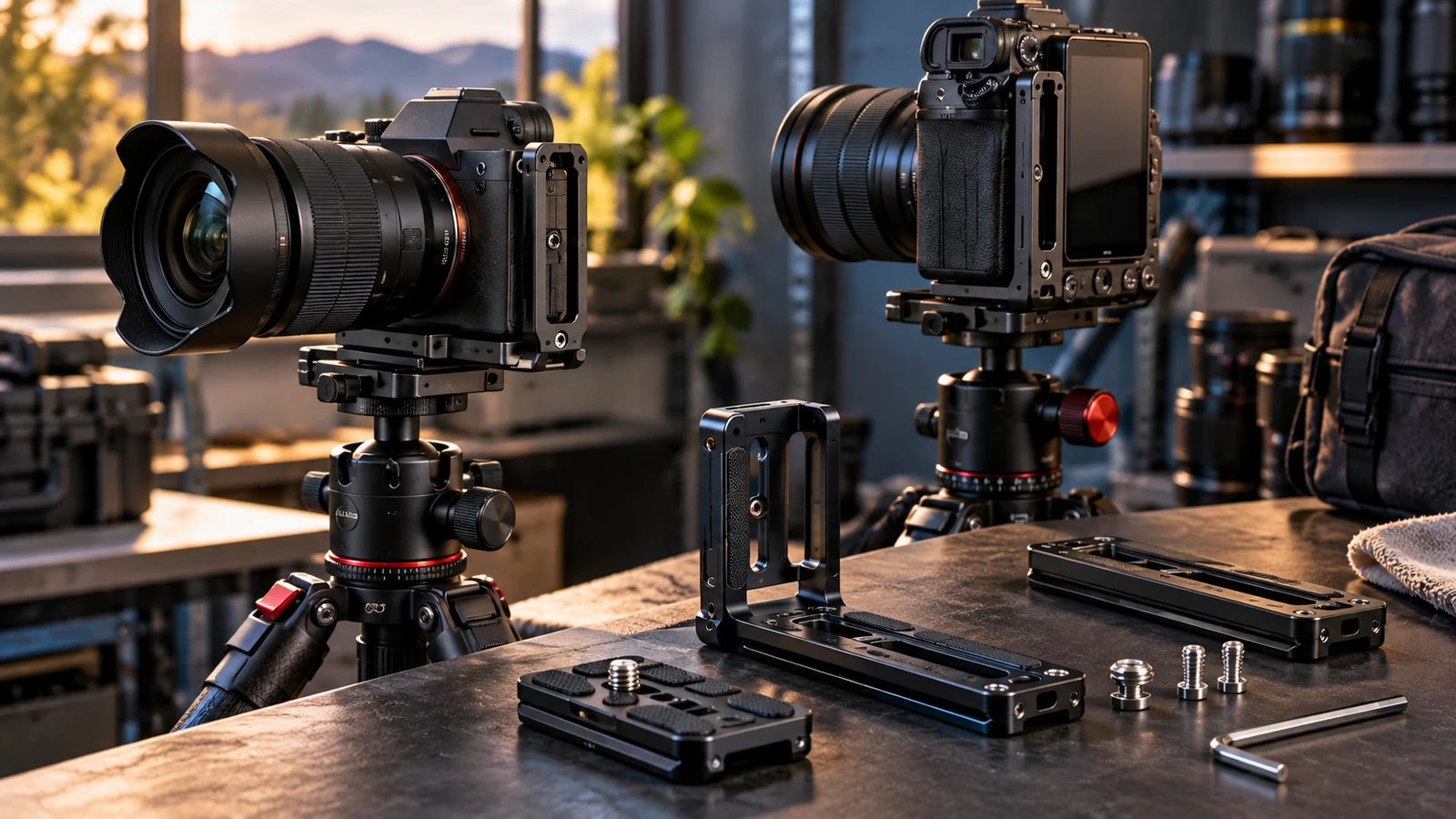
Quick-release hardware is a system. The plate, clamp, L-bracket, tripod head and gimbal all need to agree before fast switching is actually fast.
This guide looks specifically at arca-swiss vs manfrotto quick-release plates for hybrid shooters. Camera accessories are easy to buy because each part is relatively small; they are expensive to own badly because one incompatible part can force a chain of plates, cables, bags, power adapters or replacement hardware. The goal here is to identify the hard requirements before shopping.
Compare current listings for exact fit, interface standard, included parts and seller terms. Verify compatibility with your camera and workflow before ordering.
Start with the shooting problem
Arca-style dovetails are common across photo plates, cages and L-brackets, while Manfrotto-style plates remain common in video support. Adapters can bridge systems, but every extra layer changes height, balance and possible play.
Write the problem in one sentence before shopping. Examples: “I need to switch from landscape to portrait without moving the tripod head,” “I need the laptop to see files without tying up the camera,” or “I need six hours of powered studio capture.” If the accessory does not solve a problem that clear, it probably belongs on a wish list rather than in the bag.
Three realistic use cases
Still-Photo Tripod Kit
For still-photo tripod kit, prioritize existing head ecosystem and camera and cage base compatibility. Those two factors connect the accessory to a real shooting problem rather than to the number of features on the product page.
Video Fluid-Head Kit
For video fluid-head kit, prioritize camera and cage base compatibility and gimbal transitions. Those two factors connect the accessory to a real shooting problem rather than to the number of features on the product page.
Hybrid Tripod-To-Gimbal Workflow
For hybrid tripod-to-gimbal workflow, prioritize gimbal transitions and anti-twist behavior. Those two factors connect the accessory to a real shooting problem rather than to the number of features on the product page.
Five buying criteria that actually change the decision
Existing Head Ecosystem
Write down the requirement for existing head ecosystem before shopping. Measure or verify it against the actual camera, lens, cage, tripod, computer, card or power system. Camera accessories are full of near-matches, so an unstated dimension or interface should be treated as unknown rather than compatible.
Camera And Cage Base Compatibility
Write down the requirement for camera and cage base compatibility before shopping. Measure or verify it against the actual camera, lens, cage, tripod, computer, card or power system. Camera accessories are full of near-matches, so an unstated dimension or interface should be treated as unknown rather than compatible.
Gimbal Transitions
Write down the requirement for gimbal transitions before shopping. Measure or verify it against the actual camera, lens, cage, tripod, computer, card or power system. Camera accessories are full of near-matches, so an unstated dimension or interface should be treated as unknown rather than compatible.
Anti-Twist Behavior
Write down the requirement for anti-twist behavior before shopping. Measure or verify it against the actual camera, lens, cage, tripod, computer, card or power system. Camera accessories are full of near-matches, so an unstated dimension or interface should be treated as unknown rather than compatible.
Plate Length And Balance Adjustment
Write down the requirement for plate length and balance adjustment before shopping. Measure or verify it against the actual camera, lens, cage, tripod, computer, card or power system. Camera accessories are full of near-matches, so an unstated dimension or interface should be treated as unknown rather than compatible.
Fit the complete camera, not the naked body
Accessory fit should be checked with the camera configured the way you actually use it. A battery grip changes cage and L-bracket fit. A long lens changes balance. A microphone can occupy the cold shoe a monitor mount expected to use. A side-mounted USB-C or HDMI cable can collide with an L-bracket or cage handle.
Photograph the current rig from the side and back before adding another part. Mark battery, card and cable doors that need to open. If the camera uses a fully articulating screen, move it through its normal range. That ten-minute check prevents an accessory from solving one problem by blocking something more important.
Standards matter more than brand count
Camera support and rigging become easier to own when a few standards repeat across the kit. Arca-style dovetails, 1/4-20 and 3/8-16 threads, common cold shoes and standard USB-C connections can reduce adapter clutter, but even standardized-looking interfaces have limits. Plate width, locating pins, cable capability and thread placement still need verification.
SmallRig's current L-brackets, for example, use Arca-style base and side plates while also preserving access around specific camera bodies. That is the useful pattern: a broad standard implemented around a camera-specific physical fit.
Compare current listings for exact fit, interface standard, included parts and seller terms. Verify compatibility with your camera and workflow before ordering.
Cables, ports and strain relief
Modern camera rigs often fail at the smallest interfaces. USB-C, HDMI, microphone and power ports are compact and not intended to be handles. If a cable hangs with leverage or can be yanked sideways, add strain relief at the cage, plate or support before treating the setup as production-ready.
Tether Tools' current cable-management documentation makes the same point: a retention system is designed to secure the cable and remove stress from the device port. The principle applies beyond tethering. A monitor cable, power lead or trigger cable should have a deliberate route and enough slack for every movement the camera is expected to make.
Power is an electrical specification, not a plug shape
USB-C, barrel connectors and battery-shaped couplers can look compatible while asking for different power. Sony's current support documentation, for example, publishes different USB-PD output requirements depending on camera and power configuration. Canon pairs specific DC couplers with specific adapters and camera bodies.
For continuous-power accessories, record the camera's supported input method and the voltage/current requirements before shopping. For multi-device rigs, map every output from the battery plate to the device it powers. A camera, monitor and wireless transmitter may use three different voltage requirements even if they all live on the same cage.
Data workflow belongs in the buying decision
Cards, readers, tether cables and external drives are part of one data path. Buying a high-speed card reader only helps when the card, reader, host port, cable and destination storage can all use the speed. Likewise, a tether cable that is electrically connected but unreliable under movement is not a professional workflow.
Separate capture from backup. Importing files is not the same as protecting them. CameraGear's existing storage guide covers the 3-2-1 approach; this batch focuses on the hardware that gets files out of the camera or card reliably so the backup process can begin.
Rig weight and leverage add up quietly
A cage, L-bracket, monitor, handle, battery plate and cable clamps may each feel light in isolation. Together they change tripod head behavior, gimbal payload, shoulder fatigue and bag size. Weigh the working camera with the actual lens and accessories instead of adding manufacturer weights mentally.
Leverage matters as much as total weight. A monitor on a long magic arm or a battery far behind the camera can create more twisting force than a heavier part mounted close to the center. Favor compact mounting when it accomplishes the same viewing or control goal.
Weather protection is not permission to ignore water
Weather-sealed camera bodies and lenses are not the same thing as an external rain barrier. A rain cover reduces direct water exposure to controls, ports and moving lens surfaces while preserving access to the camera. Purpose-built covers such as Think Tank's Hydrophobia series are sized around lens classes and include provisions for hand and tripod access.
After wet use, dry the exterior and let damp bags, covers and straps dry before sealing equipment into storage. A dry cabinet is useful for managing a storage environment, but it is not a substitute for putting visibly wet gear away correctly.
Storage and humidity control
Electronic dry cabinets are most useful in humid environments or larger collections where opening and resealing individual dry boxes becomes tedious. SIRUI's current cabinet range illustrates the category: multiple capacities, adjustable shelves and controlled storage intended for lenses and other optical/electronic equipment.
The useful number is not a cabinet's claimed capacity in liters by itself. Lay out the bodies and largest lenses you actually own, include hoods and tripod feet if they stay attached, and leave enough clearance to remove one item without bumping three others.
Marketplace red flags
- The listing says universal but gives no dimensions, camera fit list or interface standard.
- A plate or bracket covers the battery door, card door, side ports or articulating screen in the configuration you actually use.
- A cable, coupler or power accessory uses the right connector shape but does not state the required data or electrical specification.
- A mounting accessory adds enough height or leverage to interfere with gimbal balance, tripod stability or bag fit.
- A weather or storage product implies protection without explaining fit, seams, closure or environmental control.
Used gear and accessory economics
Used mechanical accessories can be excellent buys. Inspect threads for cross-threading, clamps for uneven wear, plates for bent corners, monitor mounts for slipping joints and cage screws for damaged heads. Electronic accessories deserve additional checks: dead pixels, noisy ports, swollen batteries, intermittent cables and outdated firmware support.
Price the missing parts before calling something a deal. A cage without its locating hardware, a monitor without the correct power cable or a trigger without the camera-specific shoe interface can be more expensive to complete than buying the right version once.
Price the whole working kit
Marketplace prices move too quickly to freeze a dollar amount into a durable guide. Compare the complete setup: main accessory, cables, plates, clamps, batteries, mounting hardware, storage media, weather covers and any larger bag required after the upgrade.
Also count the cost of friction. An accessory that saves two minutes on every paid shoot can justify more than one that adds a feature used twice a year. The strongest purchases are the ones that become invisible because the workflow simply gets faster, safer or more repeatable.
Purchase worksheet
Decision worksheet: Existing Head Ecosystem
Record what the current kit provides, what problem you are trying to solve, and the minimum acceptable requirement for existing head ecosystem. Then note what else changes after the purchase: bag size, cable routing, balance, tripod plate, charging, media, weather protection or software. This exposes hidden accessory chains before checkout.
Decision worksheet: Camera And Cage Base Compatibility
Record what the current kit provides, what problem you are trying to solve, and the minimum acceptable requirement for camera and cage base compatibility. Then note what else changes after the purchase: bag size, cable routing, balance, tripod plate, charging, media, weather protection or software. This exposes hidden accessory chains before checkout.
Decision worksheet: Gimbal Transitions
Record what the current kit provides, what problem you are trying to solve, and the minimum acceptable requirement for gimbal transitions. Then note what else changes after the purchase: bag size, cable routing, balance, tripod plate, charging, media, weather protection or software. This exposes hidden accessory chains before checkout.
Decision worksheet: Anti-Twist Behavior
Record what the current kit provides, what problem you are trying to solve, and the minimum acceptable requirement for anti-twist behavior. Then note what else changes after the purchase: bag size, cable routing, balance, tripod plate, charging, media, weather protection or software. This exposes hidden accessory chains before checkout.
Decision worksheet: Plate Length And Balance Adjustment
Record what the current kit provides, what problem you are trying to solve, and the minimum acceptable requirement for plate length and balance adjustment. Then note what else changes after the purchase: bag size, cable routing, balance, tripod plate, charging, media, weather protection or software. This exposes hidden accessory chains before checkout.
Related CameraGear guides
Frequently asked questions
What should I check first before buying arca-swiss vs manfrotto quick-release plates for hybrid shooters?
Start with existing head ecosystem. If that hard requirement does not match your camera or workflow, the rest of the features are secondary.
Should I buy the most expensive version?
Not automatically. Reliability, compatibility and how often the accessory solves a real shooting problem matter more than price by itself.
Is a product marked 'universal' safe to assume will fit?
No. Verify dimensions, mount standards, connector type, battery form factor or camera-body compatibility as appropriate.
Should I buy around my current camera or future cameras?
For body-specific cages and L-brackets, buy for the camera you own. For standards such as Arca plates, quality cables, readers and storage, broader reuse can justify spending more.
Is buying used camera rigging and accessories reasonable?
Often yes. Inspect threads, clamps, cables, ports, battery contacts, screens, seals and missing proprietary hardware before treating a used kit as complete.
Why are there no permanent ranked winners here?
Camera bodies, ports and accessory ecosystems change quickly. The guide focuses on durable selection criteria and lets current marketplace listings handle inventory.
Compare current listings for exact fit, interface standard, included parts and seller terms. Verify compatibility with your camera and workflow before ordering.
Technical references
Manufacturer pages are used for interfaces and documented product behavior, not as independent rankings. Current marketplace links are intentionally separate from the technical references.